Free ASVAB General Science Practice Test
Take this free ASVAB practice test for General Science to see where you stand before test day. It covers biology, chemistry, physics, Earth science and space science, scores you instantly, and gives an explanation for every question.
No sign-up, no payment, unlimited retakes.
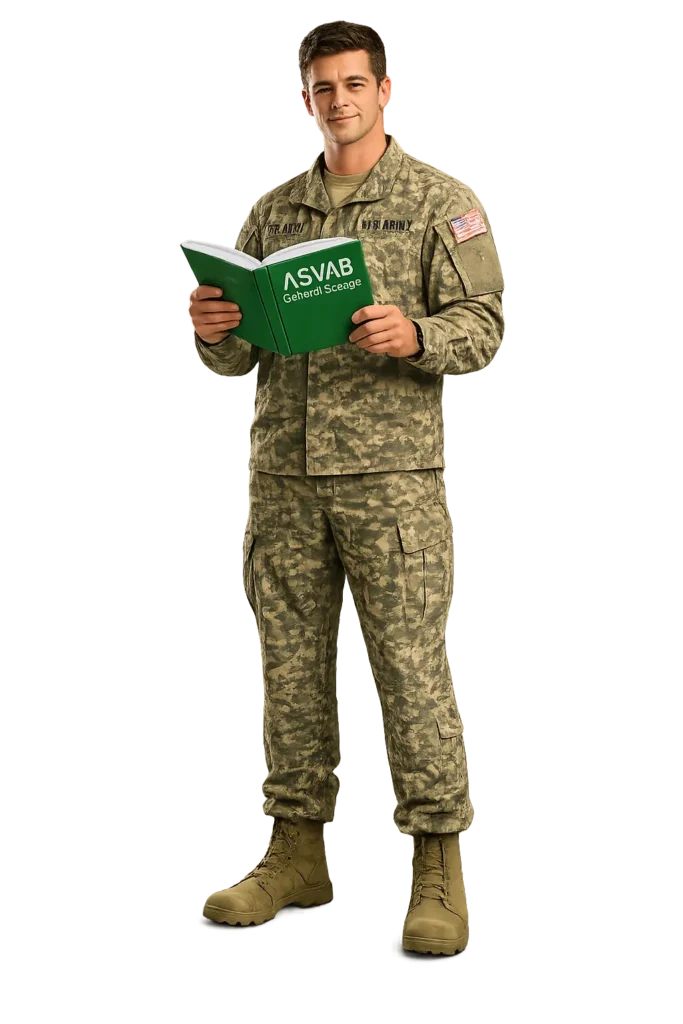
ASVAB General Science Practice Test Quiz
Test yourself with 55 free General Science practice questions covering biology, chemistry, physics,
Earth and space science. Get your score instantly and read a full explanation
after every answer.
Ecology and Classification
In a food chain, which group makes its own food and is eaten by primary consumers?
Producers such as plants and algae make food from sunlight and form the base of every food chain. Primary consumers are the herbivores that eat them, and secondary consumers eat those herbivores. Remove the producers and the whole chain collapses.
Ecology and Classification
Which list places biological classification in order from largest to smallest?
Kingdom is the largest and most inclusive group, and species is the narrowest, holding organisms so similar they can breed and produce fertile offspring. A common way to remember the order is King Philip Came Over For Good Soup.
Human Body and Health
Bile, which breaks down fats during digestion, is stored in the:
The liver produces bile and the gallbladder stores it until fatty food arrives, then releases it into the small intestine. Bile emulsifies fat, splitting large globules into small droplets so enzymes can reach more surface area.
Human Body and Health
Which chambers of the heart pump blood out to the lungs and body?
The ventricles are the lower, muscular chambers that push blood out, while the atria are the upper chambers that receive it. Because arteries take blood straight from the ventricles, blood pressure is highest in arteries and drops through capillaries and veins.
Human Body and Health
Which sequence correctly shows human development after fertilisation?
An unfertilised egg is an ovum, which travels down the oviduct, or fallopian tube. Once sperm fertilises it, it becomes a zygote, which divides and develops into an embryo and then a fetus. All of these are parts of the reproductive system.
Earth and Space Science
Which layer of the atmosphere contains the ozone layer?
The atmosphere is the envelope of gases held around a planet by gravity. Its lowest layer, the troposphere, holds most of the air and is where weather happens. Above it sits the stratosphere, which contains the ozone layer that absorbs most of the Sun's ultraviolet radiation.
Life Science and Genetics
In genetics, an organism's physical appearance is referred to as its:
Phenotype is what you can observe: eye colour, height, flower colour. Genotype is the set of alleles the organism actually carries. Two organisms can share a phenotype while having different genotypes.
Life Science and Genetics
An organism's genotype is made up of:
The genotype includes every allele the organism carries, dominant and recessive. A recessive allele can be hidden in the phenotype but is still part of the genotype and can be passed to offspring.
Life Science and Genetics
Which statement about meiosis is correct?
Meiosis divides one cell twice to make four sex cells (sperm or eggs), each with half the normal chromosome number. Mitosis is the process that makes identical body cells.
Life Science and Genetics
Which of the following is NOT a phase of cell division?
There is no phase called megaphase. The recognised stages are interphase, prophase, metaphase, anaphase and telophase, followed by cytokinesis, which splits the cytoplasm.
Life Science and Genetics
In a eukaryotic cell, DNA replication takes place in the:
The nucleus stores the cell's DNA and is where replication happens. Mitochondria make energy, the Golgi apparatus packages proteins, and the cytoplasm is the fluid holding everything.
Life Science and Genetics
A plant cell is surrounded by:
Plant cells have a cell membrane like all cells, plus a rigid cell wall made of cellulose outside it that gives the plant structure. Animal cells have the membrane but no wall.
Life Science and Genetics
Aerobic cellular respiration cannot take place without:
Aerobic means with oxygen. Cells use oxygen to break down glucose and release energy, giving off carbon dioxide and water. Without oxygen a cell must switch to much less efficient anaerobic respiration.
Life Science and Genetics
Photosynthesis uses sunlight, water and carbon dioxide to produce:
Plants capture light energy in chlorophyll and convert carbon dioxide and water into glucose, releasing oxygen as a by-product. This reaction is the base of nearly every food chain on Earth.
Ecology and Classification
Bacteria and fungi that break down dead organisms are classified as:
Decomposers break dead material down and return nutrients to the soil so producers can use them again. Scavengers such as vultures eat dead animals but do not break matter down to nutrients.
Ecology and Classification
Omnivores, which eat both plants and animals, occupy which position in a food chain?
An omnivore eating a plant acts as a primary consumer, and eating an animal acts as a secondary consumer. Its position shifts depending on what it is eating at the time.
Ecology and Classification
Some deep-sea bacteria make food from chemicals instead of sunlight. This process is called:
Chemosynthesis uses energy released by chemical reactions, often with hydrogen sulfide, to build food. It supports entire ecosystems around deep-sea vents where no sunlight reaches.
Ecology and Classification
Which symbiotic relationship occurs when one member benefits while the other is harmed?
In parasitism one organism gains at the host's expense, such as a tapeworm in an intestine. Predation is different because the predator kills its prey outright rather than living off it.
Ecology and Classification
Humans breed plants and animals to select useful traits. Darwin called this process:
Artificial selection is directed by humans choosing which organisms reproduce. Natural selection is driven by the environment with no human involvement, which is the contrast Darwin was drawing.
Ecology and Classification
An animal with an internal skeleton, such as a dog or a fish, is classified as a:
Vertebrates have an internal skeleton with a backbone. Arthropods such as insects and crabs instead have a hard external shell, called an exoskeleton.
Human Body and Health
The exchange of oxygen and carbon dioxide with body tissues takes place in the:
Capillaries are only one cell thick, so gases pass easily between blood and tissue. The bronchioles and trachea carry air, and the diaphragm is the muscle that drives breathing.
Human Body and Health
Antigens that determine a person's blood type are found on:
The A and B antigens sit on the surface of red blood cells and determine blood type. White blood cells fight infection and platelets handle clotting.
Human Body and Health
A deficiency of iron in the diet most commonly leads to:
Iron is needed to build hemoglobin, the molecule that carries oxygen in red blood cells. Too little iron means less oxygen delivery, causing the fatigue and weakness of anemia.
Human Body and Health
Which part of the brain controls balance and coordination?
The cerebellum sits at the back of the brain and fine-tunes balance and muscle coordination. The cerebrum handles thinking and voluntary movement, and the medulla controls heartbeat and breathing.
Human Body and Health
The difference between the somatic and autonomic nervous systems is that:
The somatic system controls voluntary actions such as walking. The autonomic system runs automatic processes such as heartbeat, digestion and pupil size without conscious effort.
Human Body and Health
Which of the following is NOT a function of bones?
Bones store minerals such as calcium and phosphorus, produce blood cells in the marrow, and shield organs like the brain and heart. Vitamins are stored mainly in the liver and fat tissue.
Human Body and Health
Vitamins and minerals, which the body needs in small amounts, are classified as:
Micronutrients are needed in tiny quantities but are essential. Macronutrients, which the body needs in large amounts, are carbohydrates, proteins and fats.
Earth and Space Science
The tilt of the Earth's rotational axis toward or away from the Sun causes:
Earth's axis is tilted about 23.5 degrees, so each hemisphere receives more direct sunlight for part of the year. Distance from the Sun is not the cause, which is why seasons are opposite in each hemisphere.
Earth and Space Science
The rise and fall of ocean tides is caused mainly by:
The Moon's gravity pulls on Earth's oceans and creates a bulge of water on each side of the planet. The Sun adds a smaller effect, producing especially high spring tides when it aligns with the Moon.
Earth and Space Science
A boundary where two different air masses meet is called a:
A front is the transition zone between air masses of different temperature and humidity. Most changes in weather, including rain and storms, happen along these boundaries.
Earth and Space Science
Which of the following is an igneous rock?
Granite forms when molten magma cools and hardens, which makes it igneous. Shale and sandstone are sedimentary, and marble is metamorphic rock formed from limestone.
Earth and Space Science
Earth's outer core is:
The outer core is molten iron and nickel, and its movement generates Earth's magnetic field. The inner core is solid because the enormous pressure there keeps it from melting.
Earth and Space Science
A sudden intense brightening from a small area of the Sun's surface is called a:
Solar flares are sudden energy releases usually near sunspot groups, and they can disrupt radio communication on Earth. Sunspots are cooler dark patches and quasars are distant galactic objects.
Earth and Space Science
The Big Bang theory is a model used to explain the:
The Big Bang theory describes how the universe expanded from an extremely hot, dense state around 13.8 billion years ago. It explains how the universe began, not why.
Earth and Space Science
Our Sun is classified as which type of star?
The Sun is a G-type main sequence star, commonly called a yellow dwarf. It holds over 99 percent of the solar system's mass and is roughly 4.6 billion years old.
Earth and Space Science
The main difference between a comet and an asteroid is that a comet:
Comets are made largely of ice and dust, so approaching the Sun vapourises material into a glowing coma and tail. Asteroids are rocky or metallic and stay solid. Both orbit the Sun.
Physics
Newton's First Law of Motion, which states that objects remain at rest or in motion unless acted on by an outside force, is also called the law of:
Inertia is an object's resistance to any change in its motion. It explains why passengers lurch forward when a car brakes suddenly: their bodies keep moving until a force stops them.
Physics
Which law states that force equals mass multiplied by acceleration?
Newton's Second Law, F = ma, links force, mass and acceleration. It explains why a heavier object needs more force to reach the same acceleration as a lighter one.
Physics
Sara jumped off her rowboat and the boat moved backwards as she pushed forward. This is best explained by:
Newton's Third Law states every action has an equal and opposite reaction. The force Sara applied to push herself forward pushed the boat backwards with equal strength.
Physics
The formula used to calculate the attractive force between any two masses comes from:
Universal gravitation says every mass attracts every other mass, with force increasing with mass and decreasing sharply with distance. It explains both falling apples and planetary orbits.
Physics
The energy an object has solely because of its motion is:
Kinetic energy depends on mass and speed, and it rises sharply as speed increases. Potential energy, by contrast, is stored energy that depends on position or condition.
Physics
Two objects of different mass are dropped from the same height with no air resistance. Which lands first?
Gravity accelerates all objects equally regardless of mass, so without air resistance they land together. In everyday life a feather falls slower only because air resistance acts on it.
Physics
A quantity that has both magnitude and direction is called a:
Vectors carry size and direction, such as velocity or force. Scalars have size only, such as temperature, mass or plain speed with no direction attached.
Physics
Waves bending as they pass around an obstacle or through a narrow opening is called:
Diffraction is bending around barriers or through gaps, which is why you can hear someone around a corner. Reflection bounces waves back and refraction bends them entering a new medium.
Physics
Sound waves can travel through all of the following EXCEPT:
Sound needs particles to vibrate against one another, so it cannot cross empty space. This is why space is silent, while light, an electromagnetic wave, travels through a vacuum easily.
Physics
Which list places electromagnetic radiation in order of increasing frequency?
The electromagnetic spectrum runs radio, microwave, infrared, visible, ultraviolet, X-ray, gamma in order of increasing frequency and energy. Wavelength decreases along that same order.
Chemistry and Scientific Method
The atomic number of an element is equal to its:
The atomic number counts protons in the nucleus and identifies the element. Change the proton count and you have a different element entirely.
Chemistry and Scientific Method
The modern periodic table arranges elements in order of increasing:
Elements are ordered by atomic number, meaning proton count. Arranging them this way makes elements with similar chemical behaviour fall into the same vertical column, or group.
Chemistry and Scientific Method
The smallest unit of an element that still has that element's properties is a:
An atom is the smallest particle keeping an element's identity. Break it into protons, neutrons and electrons and those properties disappear. Molecules are two or more atoms bonded together.
Chemistry and Scientific Method
A bond formed when one atom transfers electrons to another atom is:
Ionic bonds form when electrons transfer, creating oppositely charged ions that attract, as in table salt. Covalent bonds instead involve atoms sharing electrons.
Chemistry and Scientific Method
In a chemical reaction, the substances present before the reaction begins are called the:
Reactants are the starting substances and products are what the reaction creates. In a chemical equation reactants sit on the left of the arrow and products on the right.
Chemistry and Scientific Method
Which system of measurement is used as the standard in science worldwide?
Science uses the metric or SI system because it scales in powers of ten, which makes conversion simple. Its base units include the metre, gram, litre and degree Celsius.
Chemistry and Scientific Method
In an experiment, the variable that the researcher deliberately changes is the:
The independent variable is what you change on purpose, and the dependent variable is the result you measure. Everything else must be held constant for the test to mean anything.
Chemistry and Scientific Method
Which of the following is a chemical change rather than a physical change?
Burning creates entirely new substances and cannot be reversed, which makes it chemical. Melting, dissolving and boiling only change form or state, so the original substance remains.
Chemistry and Scientific Method
On the pH scale, a substance with a pH of 3 is:
The pH scale runs from 0 to 14 with 7 as neutral. Anything below 7 is acidic and anything above is basic, so lemon juice near pH 2 is strongly acidic.
ORIGINAL QUESTIONS
Free ASVAB Practice Questions With Answers
Our ASVAB practice questions are designed to help you understand the type of thinking required in
each subject. They are original preparation questions. They are not copied or leaked questions from
an official ASVAB exam.
Life Science
Cells, genetics, the human body, ecology, and classification of living things.
Earth and Space Science
Earth’s structure, rocks, the atmosphere, weather, and the solar system.
Physical Science
Newton’s laws, energy, waves, heat, atomic structure, states of matter, and acids and bases.
Every question is recall-based. There are no calculations and no word problems.
TEST FORMAT
ASVAB General Science Test Format
The core enlistment ASVAB is not a separate test for each military branch. Applicants take the ASVAB,
while each service uses AFQT and composite scores for its own eligibility
and job-classification needs.
Our branch pages help you understand which score areas and subjects may matter for the branch
and careers you are considering.
| CAT-ASVAB (computer) | Paper ASVAB | |
|---|---|---|
| Questions | CAT-ASVAB15 | Paper ASVAB25 |
| Time limit | CAT-ASVAB12 minutes | Paper ASVAB11 minutes |
| Time per question | CAT-ASVABAbout 48 seconds | Paper ASVABAbout 26 seconds |
| Change an answer | CAT-ASVABNot allowed | Paper ASVABAllowed |
| Penalty for guessing | CAT-ASVABYes | Paper ASVABNo |
Figures come from the official ASVAB Fact Sheet. Many sites still publish 16 questions in 8 minutes, which is from an older version of the computer test.
Two rules catch people out on the CAT-ASVAB. You cannot go back and change an answer once it is submitted, and unlike the paper version, random guessing is penalised. If time runs short, keep making real attempts rather than filling in answers at random.
SCORING
Does General Science Count Toward Your AFQT Score?
No. The AFQT comes from Arithmetic Reasoning, Mathematics Knowledge, Paragraph Comprehension and Word Knowledge only.
Your GS ASVAB score still matters. It feeds the line scores used for job classification, including the Army’s Skilled Technical, General Maintenance and Electronics composites, and the Air Force Electronics and Mechanical areas. A low score will not stop you enlisting, but it can rule you out of technical, medical and intelligence jobs.
FAQs